
Biography  |  Bibliography  |  Articles  |  Lectures  |  Photos  |  Videos  |  Quotes  |  Links  

Sigrid Hackenberg y Almansa - Biography

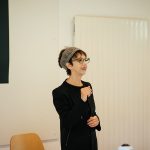
Sigrid Hackenberg y Almansa, Ph.D., was born on January 3rd, 1960, in Barcelona, Spain, to German and Spanish parents. An interdisciplinary artist and philosopher based in New York, she is an Assistant Professor of Media Philosophy at the European Graduate School, Saas-Fee, Wallis, Switzerland. Her scholarly research interests lie within Continental philosophy and feminism. Recent essays have focused on such topics as the philosophy of language, the act of reading and writing, and ‘ethics as first philosophy.’ She is the author of a forthcoming study on the writings of G.W.F. Hegel and Emmanuel Levinas (Atropos Press). A book focusing on the topic of language and the feminine is currently in preparation. Hackenberg y Almansa’s latest video and sound installation, focusing on the subject of the Spanish Civil War and created in collaboration with Dolores R. A. Hackenberg, was recently commissioned by the Museo Extremeño e Iberoamericano de Arte Contemporáneo (MEIAC), Badajoz, Spain.

Hackenberg y Almansa grew up in Spain, Germany, Japan, Canada and the United States, and was awarded a Bachelor of Art and Master of Art from San Francisco State University and New York University, respectively. In 2006, she was awarded the degree of Doctor of Philosophy with distinction from the European Graduate School for her dissertation, Total History, Anti-History and the Face that is Other. Focusing on the writings of G.W.F. Hegel and Emmanuel Levinas, this project inverts Hegel’s Phenomenology of Spirit into a phenomenology of the body and/or bodies, in the plural, via Hegel’s Philosophy of History, here invoked by the author as ‘the figure of total history,’ while Emmanuel Levinas’ ‘face to face’ encounter is considered under the notion of the ‘pre-original,’ ‘an-archic,’ and ‘anotherthantime’ as they engage in the interruption of history.

As Hackenberg y Almansa notes, "Total History, Anti-History and the Face that is Other motions towards a metaphysics of the body that is identically groundless—ground, wherein the delineation of the body, in propinquity, contradiction, and separation—as the body of a point of departure—assumes the possibility of a duplicity of existences and time(s) that is at once itself (the Same) and its interruption (the Other and/or Infinity)."

Moreover, she adds, "It is truly remarkable that the Hegelian dialectic, in pursuing the trajectory of Spirit, Reason, Historicity, and the notion of absolute Freedom, be the source of a profound shifting, not only within the notion of Spirit, History, and Nature, but equally in designating a radicalization that spurs a turning upon the inception of a knowledge or thinking concerning the idea of the body, a human body that is identically corporeal and otherthanbody (Ding an sich). Notably, Hegel radicalizes the notion of the body as a decisive conflict, which itself holds and holdsnot that which is conflicted."

Hackenberg y Almansa’s current philosophical projects explore language as it finds ‘itself/themselve(s)’ between, beneath, or beside borders in arenas which call for the unraveling of territories and nationalities. Polyvalent in execution, her writings invoke a myriad of languages – archaic, modern, future, in past and present tenses. Actively re-inscribing philosophy in the feminine and alluding to écriture féminine, her writings elucidate a revelatory and precipitous language, often engaging the works of such seminal theorists and philosophers as Irigaray, Ettinger, Derrida, Cixous, Daly, Lorde, Lacan, and Heidegger. Effectively poised between philosophy, poetry, and fiction, and situating itself at the limits of language, Hackenberg y Almansa’s writings engage in territories still unknown, unspoken, and to be thought.

In her essay, ‘strangeness Uponlanguage that is no place / the Levinasian promise of anothers’Sacredlessness,’ Hackenberg y Almansa explores the notion of a divine and revelatory language. She notes: "We therein amplify the privilege that emanates upon the infinitelysacred of tongues, and twist and entwine the holy, revered, and reverential upon a path(lessness) that exalts even reason(s) unreason and unprotects, as it were, that which we may indicate or befall upon the very premise or promise that is philosophy, shelterlessness and its inverse, refuge, asylum, and sanctuary, that is, homelessness and ‘non-protection’ delineating an ‘outside where nothing covers everything.’"

Hackenberg y Almansa’s artistic practice is likewise interdisciplinary in nature, with a particular emphasis on the creation of video and sound projection installation displays. Hackenberg y Almansa’s current installations focus on the subject of history, memory, and performativity. Exploring key historical moments wherein momentous political forces move in diverse directions, the installations have focused on a diverse range of subjects such as the Abu Ghraib prison scandal in Iraq, the life and death of Rosa Luxemburg, Nazism, the Holocaust, and the Resistance, and more recently, the Spanish Civil War. Cinematic in scale, and epic in character, the newest installations allude to Richard Wagner’s concept of the Gesamtkunstwerk (Total Work Of Art) and Walter Benjamin’s notion of the Trauerspiel (Work of Mourning). Her work has been exhibited in museums and galleries in Europe, Asia, and the United States.

Sigrid Hackenberg y Almansa is a professor of philosophy at the European Graduate School in Saas-Fee, Switzerland, where she teaches an Intensive Summer Workshop.