
EGS Home MA in Communication PhD in Communication Admin FAQ Faculty EGS Store    EGS Services
European Graduate School EGS logo EGS locations
Media and Communications EGS Graduate and Post-Graduate Studies
EGS StarFormer European Graduate School Faculty

Christian Marclay


Biography | Lectures | Bibliography | Resources | Links

Photos

Quotes  Top  

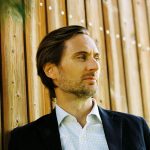
Christian Marclay at the European Graduate School in Saas-Fee, Switzerland.
Enlarge Image
Place caption text here 2
Enlarge Image

Christian Marclay at the European Graduate School in Saas-Fee, Switzerland.

Christian Marclay at EGS in Summer 2002.


Quotes

Photo  Top  


Old records have the quality of time passed, this sense of loss. I am trying to bring it back to life through my art.
Christian Marclay

With the Ready Made, the decision to remove oneself from the election process is close to improvisation. When you're improvising you try to be as innocent, as spontaneous as possible, although you can't help but put in everything you know.
Christian Marclay

Sound informs image so much. It really influences the image completely and reinforces the illusion. The soundtrack in a film is always more subliminal.
Christian Marclay

Music is material. Recording technology has turned music into an object, and a lot of my work is about that object as much as it is about the music. […] One doesn't necessarily think of music as a physical reality, but it has physical manifestations. It can also be an illustration, a painting, a drawing.
Christian Marclay

… There's something about scratching a record that has become so glamorized, so photogenic that it's a cool thing to do. Maybe 'cool' is really the word because it's so detached and so distant in relation to live music …
Christian Marclay

I want my work to be about the aural, but it doesn't necessarily have to be about music.
Christian Marclay

Music is a very popular experience that anybody can relate to. It's a lot more popular than painting. [And in any case, in] a performance you have the visual presence of someone producing sound. In my work I'm constantly dealing with the contradiction between the material reality of the art object as a thing and its potential immateriality. In a way immateriality is the perfect state, it is the natural outcome of the ephemeral. In music this aspect of immateriality is very liberating. Ideally I would like to make art that is invisible.
Christian Marclay

I was more interested in the music scene than the art galleries and museums. I thought there was more energy in new music scenes and for me new music was punk rock, it what I knew, what I had discovered in NY.
Christian Marclay

In film, the narrative structure comes first and the music underlines the narrative and emotion, but sometimes they cut, they jumpcut. In film editing, change is very radical from one scene to the next, rather than a kind of transition that more traditional music would require. So if you just listen to the film, you know…. if you close your eyes and become more aware of a kind of quick change in the sound.
Christian Marclay

They were just thrift store records - I never spent more than a dollar on a record. It was just junk, and I would stick things on them to make them loop. I even used an old wind-up gramophone that I found in the garbage. It was also at MassArt that I found these great turntables (Califone) that I've been using ever since. They used to be in every school's audio-visual department for instructional presentations.
Christian Marclay

I could only afford records in thrift stores. Then you could find wonderful things, but now everything is a collectible. I like the recycling idea - using the stuff that people don't want anymore, and make new music out of it. There was an element of looking back and listening to your parents' records and doing something with that stuff. Sort of acknowledging the past while rejecting it at the same time.
Christian Marclay

Sometimes people will hear something, and they'll ask 'did you play this' when I actually didn't. It's interesting that audiences have this need to identify the source material. Once different unrelated records are combined, they sometimes have the power to trigger the memory of a tune.
Christian Marclay

I don't consciously make music to trigger memory but it happens naturally. Music has such powers in triggering memory, collective memory and private memory. What I consciously try to do is to use the widest variety of music.
Christian Marclay

These records often have different sets of references for different people, because most memories are personal and subjective. Whatever happens in their mind is something that I can't control, I can't control what they think about what I'm doing. It's like silent audience participation.
Christian Marclay

[…] When I listened to a record, there were all these unwanted sounds, clicks and pops, because of the deterioration of the record, the surface noise, scratches. Instead of rejecting these residual sounds, I've tried to use them, bringing them to the foreground to make people aware that they're listening to a recording and not live music. These sounds make people aware of the medium, of the vinyl, a cheap slab of plastic. It's something so important because it's the way that we relate to music most of the time, through recordings. We usually make abstractions of the medium. For me, it was important to have this awareness and underline it, to give it a voice. It has an expressive power in itself. When something goes wrong, like when the needle skips, something unpredictable happens, that wasn't the intention of the recording artist. In that incident, something new and exciting happens. For me, it has creative potential.
Christian Marclay

[…] People hear music mostly through recordings, the recording becomes the reference, the template. Musicians try to reproduce their CD's on stage, the audience already knows the music through the recording and that's what they are expecting to hear.
Christian Marclay

When I listen to live recordings of my performances, I become very critical, a recording is not a live concert, it requires a different listening, and it changes with multiple plays. When you're performing live, you're really responding to the moment. A section may feel good live, but as a recording it drags, it doesn't have the same intensity it did when you were present because you're missing the visual, the process.
Christian Marclay

In my work the process is very important, to be able to see it and hear it. I'm using these records and you can see how I manipulate them and abuse them. Everything, the pace that the records get changed, how long they stay on the turntables, what kind of shape they're in, the manipulations, etc. All these actions inform the listening. I use the recording studio very differently. When you're not on stage, you can go back and try again and edit. The studio is another instrument. I don't want the listener to forget it is a recording.
Christian Marclay

CD's are part of a different technology. They're not as simple and mechanical as records and turntables. … But you can't physically scratch a CD or cut it in half and expect the machine to still play it. And performing with a CD on-stage is not very exciting visually.
Christian Marclay

The great thing about hip-hop is that it really made DJ'ing more of an accepted craft. MTV also helped in giving the scratched sound a gesture, showing the hand of the DJ back spinning, it became such a cool gesture and now everybody wants to scratch. I see kids now air-scratching while walking around with their walkman. That sound and the way it was used in hip-hop, scratching a beat and hearing the record go back and forth has become so natural in the pop music landscape. Now it's a staple sample on most keyboards. It's a normal sound now, but it was a revolutionary sound in the 80's - it really made the use of found sounds acceptable in pop music.
Christian Marclay

Some people just listen to music others just look at art, some do both but they don't do it in the same place. It's sad that a lot of people can't be open-minded enough to be curious about something they don't understand. … Everybody experiences music one way or another, music is usually more democratic than art, so I feel I can touch more people with it, even if I make a piece that doesn't make any sound, but deal with notions of perception of sound. We take a lot of our sound experiences for granted. We don't question sounds as much as images.
Christian Marclay

So its seems that to be famous you either have to make pop music or get sued by pop music. It's great work because it doesn't fit into any clean little box and it's very political. They are critical of the music industry but they're also totally dependent on these machines that the industry puts out like samplers and tape recorders. There's a contradiction between what's out there - available machines to record and remix - and the legal system. I don't have a clear answer to the copyright issue but there's this huge contradiction between what artists are doing and what the law wants to set up. Sony corporation makes the machines but they'll sue you for using them.
Christian Marclay


EGS StarTop of this PageEuropean Graduate School HomepageEGS SitemapEGS Star

EGS FACULTY
Giorgio Agamben
Chantal Akerman
Pierre Aubenque
Alain Badiou
Lewis Baltz
Nicholson Baker
Jean Baudrillard
Yve-Alain Bois
Catherine Breillat
Victor Burgin
Judith Butler
Hélène Cixous
Diane Davis
Manuel DeLanda
Claire Denis
Atom Egoyan
Tracey Emin
Chris Fynsk
Peter Greenaway
Werner Hamacher
Barbara Hammer
Donna Haraway
Michael Hardt
Martin Hielscher
Michel Houellebecq
Shelley Jackson
Freidrich Kittler
Claude Lanzmann
Carl Mitcham
Jean-Luc Nancy
Antonio Negri
Cornelia Parker
Laurence Rickels
Avital Ronell
Martha Rosler
Wolfgang Schirmacher
Volker Schlöndorff
Michael Schmidt
Hendrik Speck
DJ Spooky/Paul Miller
Bruce Sterling
Sandy Stone
Fred Ulfers
Gregory Ulmer
Agnès Varda
Victor Vitanza
H. von Amelunxen
Samuel Weber
Lebbeus Woods
Krzysztof Zanussi
Siegfried Zielinski
Slavoj Zizek