
Biography  |  Bibliography  |  Articles  |  Lectures  |  Photos  |  Videos  |  Quotes  |  Links  

Laura U. Marks - Biography

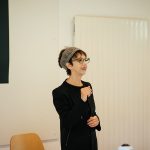
Laura U. Marks, Ph.D. is an American media theorist and artist. She is Dena Wosk University Professor in Art and Culture studies in the School for the Contemporary Arts at Simon Fraser University, and a professor at the European Graduate School where she teaches an intensive summer seminar.

Laura U. Marks has worked as an editor, curator, professor, critic and scholar. From 1987-91 she was the assistant editor at Afterimage magazine. Since 1991 she has been an independent critic, curator and editor. From 1993 to 1995 she was media curator at the Pyramid Arts Center in Rochester, New York. In 1994 Laura U. Marks was the Rush Rhees Fellow at the University of Rochester. That same year she was a dissertation fellow for the Luce Foundation / American Council of Learned Societies. From 1995-1996 she was a Mellon / Pew Fellow in the Division of Critical Studies at the California Institute of the Arts. From 1996 - 2001 she was an Assistant Professor of Film Studies at Carleton University. She obtained Tenure in 2001 at Carleton University. From 2002-2003 she was a visiting scholar at the Center for Behavioral Research at the American University in Beirut. Since 2003 she has been a tenured associate professor and Dena Wosk University Professor in Art and Culture Studies, School for the Contemporary Arts, at Simon Fraser University.

These engagements in a number of diverse institutional and theoretical models give light to her unique and innovative works. She has demonstrated a superb fascination for culturally specific history and contextual understandings of historical situations. These have given her a unique voice and perspective that is clear throughout her numerous papers, books, and articles, and extends to the untraveled areas in which others have long ignored or simply not searched for a confluence of radical similarities in radically different landscapes. She is also fluent in both written and spoken French and Arabic.

From the beginnings of her academic career as an undergraduate at Swarthmore, Marks has possessed an interest in the fields of study, or more properly the interstitial spaces between these fields of study, in which the visual, the anthropological, and the sociological touch, or almost touch, or fail to do so. In 1994 Lauar U. Marks obtained her B.A. with high honors in Art History and Sociology/Anthropology from Swathmore College. Thus, her primary concern might be said to be the tactile, or by her words, the apparent oxymoronic phrase "haptic visuality," and by extension the ontological properties of both the artist or viewer and culturally-bound to the evocation of certain haptic memories through different forms of media. She continued her interest with her masters work at the University of Rochester, where she obtained her M.A. in Visual and Culture Studies in 1994.

In 1996, after earning her PhD in Visual and Cultural Studies from the University Rochester, Marks began to develop her dissertation, "The skin of the film: Experimental cinema and intercultural experience", into what would become her first theoretical volume of the same name, subtitled: Intercultural Cinema, Embodiment, and the Senses (2000). In this work, influenced by the philosophy of Gilles Deleuze, Laura U. Marks explores both the way that cinema can evoke a bodily awareness. Through examining the intersections between culture and visual presentation she delves into a realm of politically charged possibilities. Presence of non-visual memories and attempts to answer the question of how touch, smell and presence--our primary triggers for culturally-specific and individual units memory--can be embodied in visual media that necessarily eschew these triggers. In a review of this work Tamara Vukov writes:

By examining how haptic visuality is employed in intercultural cinema to create a physical sense of place for diasporic communities through memories of the senses, smells, tastes,, and bodily presence of their home cultures, she insists on the epistemological significance of affective modes of sensation and embodied memory in cultural knowledge and media images.

Marks continued down the same trajectory of research and insight for her subsequent volume, titled appropriately, Touch (2003). The chapters in this volume took on a more personal character as Marks began to step outside, or inside the cultural experience, to a more subjective approach, that expired haptics and visual work through the lens of Feminism, Post-Femenism, Film Theory, Gender theory, Queer Theroy, and other established and more radical perspectives in order to gain more insight into the visual artist and the self. Many academics have pointed towards Laura Mark’s work as encomapassing the “embodied turn" in contemporary academic discourse. But Laura U. Marks feels that this turn has become somewhat “reactionary" and “anti-intellectual", while not denying the importance of the embodied experience and is turning towards other forms of critique.

Her latest book, Enfoldment and Infinity : An Islamic Geneaology of New Media Art (2010), returns to her previous concerns of visual culture and cultural knowledge, but this time her approach is specific and historical in nature, examining the touching points of classical Islamic art/philosophy, and contemporary New Media. Using haptic transfer, or a philosophy of touch and travel, as the central metaphor, she brings together abstract mathematical discoveries of classical Islam and the visual technology developed to represent these, to make of them a holistic paradigm of knowledge and thought, which are embodied in the so-called abstract line" that stretches from the fundamental geometric concerns and realities and discoveries of classical islam westward to ethics and aesthetics of modernism that ultimately informs contemporary new media. Siegfried Zielinski says the following about Emfoldment and Infinitiy:

After reading Laura Marks’s lucid Enfoldment and Infinity, which leads us through the deep time layers of Arabic-Islamic arts and sciences, we have to give up our established concepts of media history. … Chapter by chapter, it becomes evident that some of the most important modern paradigms like pixels, algorithms, morphs, or even virtual reality and artificial life have not been originally generated by the Occident, but through L’Age d’Or of the Orient.

When questioned in a recent interview about the connection between digital worlds and Islamic art, she has the following response:

Well, I can say what, for me, electrons and Islamic art have in common. It may have started three or four years ago when I wrote ‘How Electrons Remember.’ I was getting more and more frustrated with representational images – that they are so easily colonized – and looking more and more to ways to escape representation. So I started thinking about electrons, as a kind of indexical medium that’s ‘under the radar’ of representation, and also about smell. Smell is a medium that is hard to corral into being representational. Then I got interested in Islamic art as an art form that is really good in both being representational and collapsing all that down to a point. Certain kind of calligraphy, for example, can start from a single point from which a whole line can be implicit, but then be reduced back to a single point. I found that Islamic art has that quality of latency that I also find really interesting in software art.

Laura U. Marks publications include: Enfoldment and Infinity: An Islamic Genealogy of New Media Art. (MIT Press. 2010), Touch: Sensuous Theory and Multisensory Media. (University of Minnesota Press. 2002), The Skin of the Film: Intercultural Cinema, Embodiment, and the Senses. (Duke University Press. 1999), "Genetic algorithms, Kunstwollen, and Caucasian carpets." in: Andreas Broeckmann and Gunalan Nadarajan (Editors). Place Studies in Art, Media, Science and Technology: Historical Investigations on the Sites and the Migration of Knowledge. (VDG Weimar, 2008), "Thinking Multisensory Culture." in: Paragraph. (July 2008), "Thinking Multisensory Culture." in: Ettina Papenberg and Marta Zarzycka (Editors). Carnal Aesthetics: Transgressive Imagery and Feminist Politics., “Experience – Information – Image : a historiography of unfolding. Arab cinema as example." in: Cultural Studies Review. (March 2007), “Geopolitics hides something in the image; Arab cinema unfolds something else." in Bélen Vidal, Dina Iordanova and David Martin Jones (Editors). Cinema at the Periphery. (Wayne State University Press. 2010), “Immigrant semiosis." in: Susan Lord and Janine Marchessault (Editors). Fluid Screens, Expanded Cinema: Digital Futures. (University of Toronto Press. 2007), "The Haptic Transfer and the Travels of the Abstract Line: Embodied perception from classical Islam to modern Europe." in: Christina Lammer and Kim Sawchuk (Editors). Verkörperungen/Embodiment. (Löcker Verlag. 2007), "Mémoire et implication: les origines islamiques des médias numériques." in: Claude Filteau and Michel Beniamino (Editors). Mémoire et culture. (Presses Universitaire de Limoges. 2007) and “Asphalt Nomadism: The new desert in contemporary Arab cinema." in: Martin Lefebvre (Editor). Landscape Cinema. (Routledge, 2006).

Laura U. Marks is a professor at the European Graduate School in Saas-Fee, Switzerland, where she conducts an Intensive Summer Seminar.